Browse available tours on Viator →
The Pilgrim's Guide to Varanasi
One of the world's oldest cities, where the Ganges, death, and devotion share the same riverbank.
Why it made the cut: I verified this tour in February 2024. The operator maintains high safety standards and local guide quality.
Varanasi is older than almost every city you have ever visited. It has been a center of learning, devotion, and death for more than 2,500 years, a place where Hindus come to die, where Buddhists come to trace the footsteps of their teacher, and where travelers from every corner of the world come to encounter something they cannot find at home: a city that has made peace with mortality and built a civilization around it.
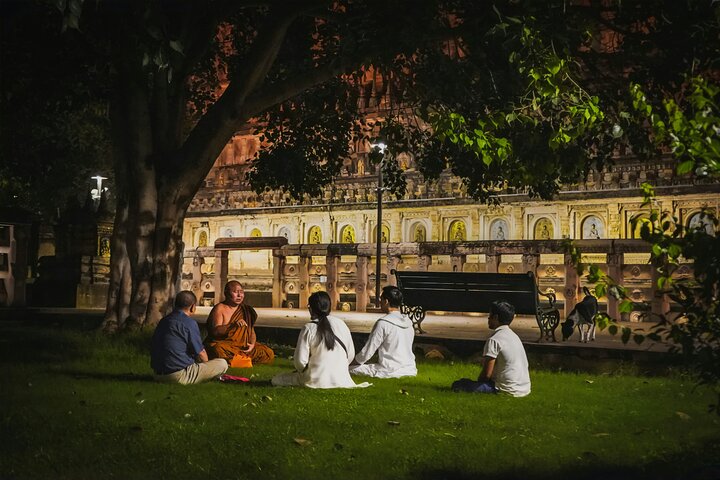
This guide is written for visitors who are coming to Varanasi with some form of spiritual intent, whether they identify as Hindu, Buddhist, or as someone who wants to understand what human beings have done with the fact of their own deaths. Each section covers a specific aspect of the city, the Ghats, the Aarti ceremony, Sarnath, death and the river, with enough context to help you arrive prepared.
Varanasi does not explain itself. Its meaning is not obvious on the surface. A guide who has grown up here, not a guidebook, is the best you can have.
The Ghats of Varanasi
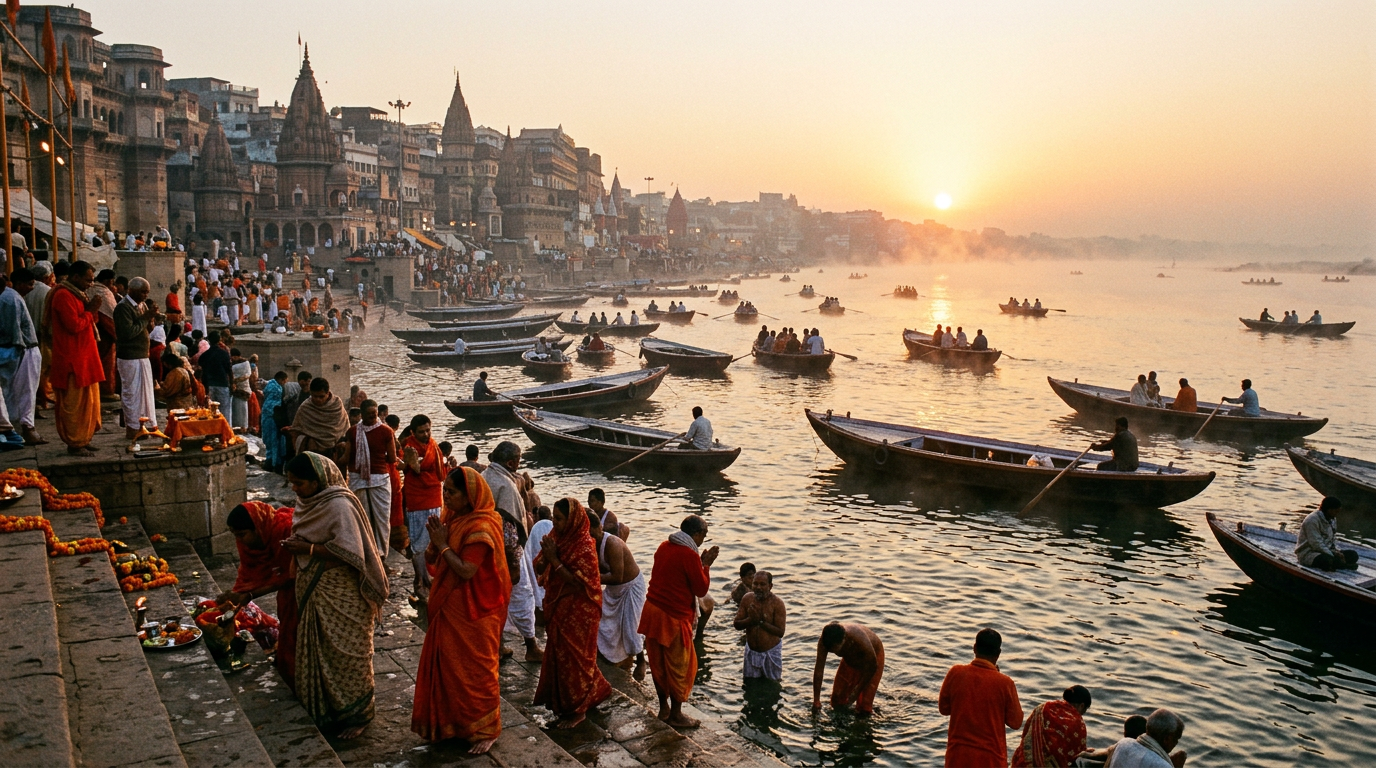
Eighty-four stone steps descend to the Ganges along the western bank of the river — 84 Ghats, each with its own character, its own history, and its own community of users. Some are for bathing, some for cremation, some for political speeches, some for morning prayer, some for evening trade. They are not interchangeable. Understanding the difference is the beginning of understanding Varanasi.
Dashashwamedh Ghat is the main ghat, the one closest to the old city bazaar and the one where the evening Aarti is performed. It is always crowded, always busy, and always a little overwhelming. Come here for the Aarti; come back to the quieter ghats for the experience of the river itself.
Manikarnika Ghat is the main cremation site. Fires burn here every day, all day, the bodies of Hindus who have come to Varanasi specifically to die, or whose ashes are brought here for immersion. This is not hidden. The burning is visible from the river. The smoke rises. Families wait. This is not a spectacle, it is the point. Hindus believe that dying in Varanasi, or having your ashes immersed in the Ganges here, grants moksha, liberation from the cycle of rebirth. Our guides explain the theology behind what you are seeing so it makes sense, not so you feel like a spectator.
Assi Ghat is at the southern end of the ghat sequence, quieter, more residential, popular with students and long-stay visitors. The morning prayers here are less staged than at Dashashwamedh and feel more immediate. This is where many visitors come to sit quietly in the mornings and evenings.
What it feels like: The Ghats are wet, loud, crowded, and alive at almost every hour. Buffaloes wade in the shallows. Children swim. Women wash clothes. Sadhus, ascetic holy men, sit in ash or ochre robes. The smell is river water, woodsmoke, incense, and jasmine garlands. Nothing is staged for tourists, but visitors are welcome to observe and participate. The key is a guide who can narrate what is happening and why.
The Aarti Ceremony
The Ganga Aarti at Dashashwamedh Ghat is one of the most performed rituals in Hinduism, five priests, brass lamps, Sanskrit chants, a conch shell, and a river that has received these offerings for centuries. At dusk, the priests lift large oil lamps and move them in precise, synchronized gestures while the crowd, sometimes hundreds of people on the ghat and hundreds more on the boats in the river, watches in silence and prayer.
It is crowded, it is loud, and it is extraordinary. The setting sun turns the Ganges gold. The lamps catch the last light. The chant goes on, and the river receives it.
The morning Aarti — performed at dawn, usually from a boat on the river, is different in character. Quieter, more intimate, with the light coming up over the eastern bank. This is often the more powerful experience for visitors who want to understand what the ritual means, the boat position gives you the whole scene without the push of the evening crowd. For a full comparison of morning vs evening Aarti ceremonies, see our Ganga Aarti guide.
What to expect: Arrive 30–45 minutes before the ceremony to get a position near the front. If you are on the ghat steps, you will be jostled. If you are on a boat, you will have a better view but less sense of the sound. Both are valid. A good guide will position you based on what you want to understand, the ritual, the crowd, or the river.
Sarnath — Where the Buddha First Preached
Ten kilometers from central Varanasi, Sarnath is where Gautama Buddha gave his first sermon after attaining enlightenment, the setting in motion of the Wheel of Dharma. This is one of the four most important sites in Buddhism (the other three are Lumbini (birth), Bodh Gaya (enlightenment), and Kushinagar (death)). For Buddhist pilgrims, visiting Sarnath is not optional, it is essential.
The Dhamek Stupa marks the site where the Buddha gave his first sermon. It is a massive cylindrical structure, approximately 43 meters in diameter and 43 meters high, covered in carved stone depicting figures from Buddhist tradition. The current structure dates to the 5th century CE, though the site itself has been continuously honored since the 3rd century BCE when Emperor Ashoka erected a pillar here.
The Ashoka Pillar stands near the Dhamek Stupa, one of several Ashoka Pillars across India marking sites significant in the Buddha's life. The four lions at the top became the emblem of the Republic of India. The pillar's inscriptions record Ashoka's own Buddhist faith and his commitment to religious tolerance.
The Sarnath Archaeological Museum holds one of the most important collections of Buddhist art in the world, including the famous Lion Capital of Ashoka, theof and the serene Buddha-headless torso that many consider the finest example of Gupta-period sculpture in existence. The museum is well worth the time and the INR 25 entry fee.
How to combine with a Varanasi visit: Most visitors do a morning boat tour on the Ganges and then drive to Sarnath in the late morning or early afternoon. Sarnath takes 2–3 hours if you include the museum. The return drive to Varanasi takes approximately 30 minutes. For a complete day-trip planner to Sarnath, see our Sarnath guide.
Death and the Ganges
Every day, multiple bodies are cremated on the Manikarnika and Harishchandra Ghats. The wood for the pyres is stacked nearby, the cost of the wood and the cremation is paid by the families, and there is a system of charity for those who cannot afford it. The fires burn all day. The smoke rises. The Ganges receives the immersed ashes of pilgrims who come from across India carrying the remains of loved ones.
For visitors who have not encountered this before, it can be confronting. It is not meant to be hidden. The openness of the cremation fires at the Ghats is, for Hindus, precisely the point, death in Varanasi is not a private or clinical event. It is a communal, ritual act that happens in the middle of the city, in the sight of the river, witnessed by anyone who is there.
The theology behind it: Hindus believe that the Ganges is not just a river. It is the goddess Ganga, a divine presence that has the power to cleanse karma and grant moksha, liberation from the cycle of rebirth. Dying here, having your body immersed here, having your ashes scattered here, these are understood as among the most spiritually beneficial acts a Hindu can perform. Varanasi is understood as the city of liberation.
What to do if you encounter this: If you encounter a cremation during your visit, observe quietly. Do not photograph cremations, this is considered deeply disrespectful by families at the Ghats, and by most Indian visitors. A good guide will tell you when to give space. The experience of witnessing this openly, without it being hidden or sanitized, is part of what Varanasi has to teach.
The Old City Lanes
Varanasi's old city is a maze. The lanes are too narrow for vehicles, everything moves on foot, by bicycle, or by motorbike. The walls are close, the light is low, the sounds are specific: temple bells, call to prayer from the mosques, someone cooking, someone arguing, the river somewhere close but not visible. Most tourists never go beyond the main ghat area and the bazaar street that connects to it.
Our guides know the routes and can navigate you from the Ghats into the markets, the temples, the narrowest lanes, and the quiet courtyards that most tourists never find. Getting lost is half the experience. Getting unlost is the other half.
The temples: Varanasi has hundreds of temples, mostly associated with Shiva (Kashi Vishwanath, the Golden Temple, is the most important) but also with Durga, Kali, and the goddess of the river. Many are small, a sanctum in a lane, a deity in a niche, a priest who opens it at specific hours. The guide will know which ones are open, which ones are worth entering, and which ones require you to remove your shoes.
The markets: The main market near the Ghats sells everything, silk scarves, brass lamps, Rudraksha beads, marigold garlands, spices, chai. Prices are inflated for tourists; the guides help you understand what's fair. The silk andBanarasi saree weaving districts require a separate visit — Varanasi silk is one of the city's great crafts, and a visit to a weaver's workshop is a different kind of cultural encounter.
Frequently Asked Questions
What is the dress code for visiting the Ghats and temples in Varanasi?
Modest dress is expected, shoulders and knees covered for everyone. For women, a long kurta or loose trousers with a top that covers the shoulders works well. For men, long trousers and a shirt or kurta. You do not need special clothing, avoid shorts, sleeveless tops, and tight clothing. You will remove shoes at temples; bring socks for the stone floors.
Can non-Hindu visitors understand Varanasi, or is prior knowledge required?
No prior knowledge is required. Varanasi is one of the world's most accessible places for spiritual visitors from other traditions. A good guide will help you understand what you are seeing without requiring you to share the beliefs behind it. Coming with curiosity and respect is enough.
Is Varanasi safe for solo travelers and solo female travelers?
Varanasi receives millions of pilgrims and tourists every year. The Ghats are populated at all hours. Standard urban travel precautions apply. Solo female travelers may be asked to pose for photographs, this is usually harmless but can be annoying. Our guides stay with groups throughout. If you are traveling independently, stay near the main Ghats and use a registered guide.
Is the Ganges safe to be near?
The Ganges carries water quality risks, do not drink the water and avoid submerging your head. For most of the year the Ghats are safe to walk on and observe from. During the monsoon (June–September) some Ghats can flood and become hazardous. Our guides monitor conditions and adjust itineraries accordingly.
What is the best of day to visit the Ghats?
Dawn (5–7am) and dusk (5–7pm) are when the Ghats are most themselves. Dawn is quieter, more contemplative. Dusk brings the Aarti ceremony. Midday is hot and the light is flat, use this time to visit Sarnath, the temples, or retreat to your hotel.
Can I combine Varanasi with Bodh Gaya?
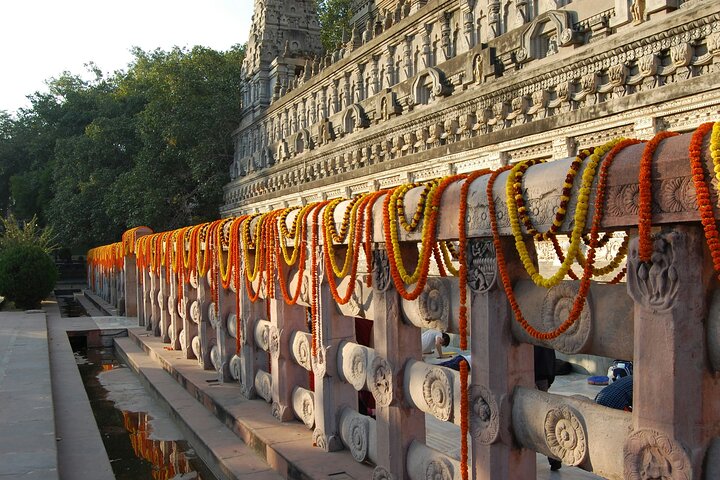
Yes. The drive from Varanasi to Bodh Gaya takes approximately 5–6 hours by road. Our Full-Day Private Bodh Gaya tour from Varanasi covers the Mahabodhi Temple, the 80ft Buddha Statue, and the Thai Monastery. It is a powerful pairing: Hindu devotionalism on the Ganges, followed by Buddhist stillness in Bodh Gaya. Read our Pilgrim's Guide to Bodh Gaya for everything you need to plan the visit.