Browse available tours on Viator →
Sarnath: Buddha's First Sermon
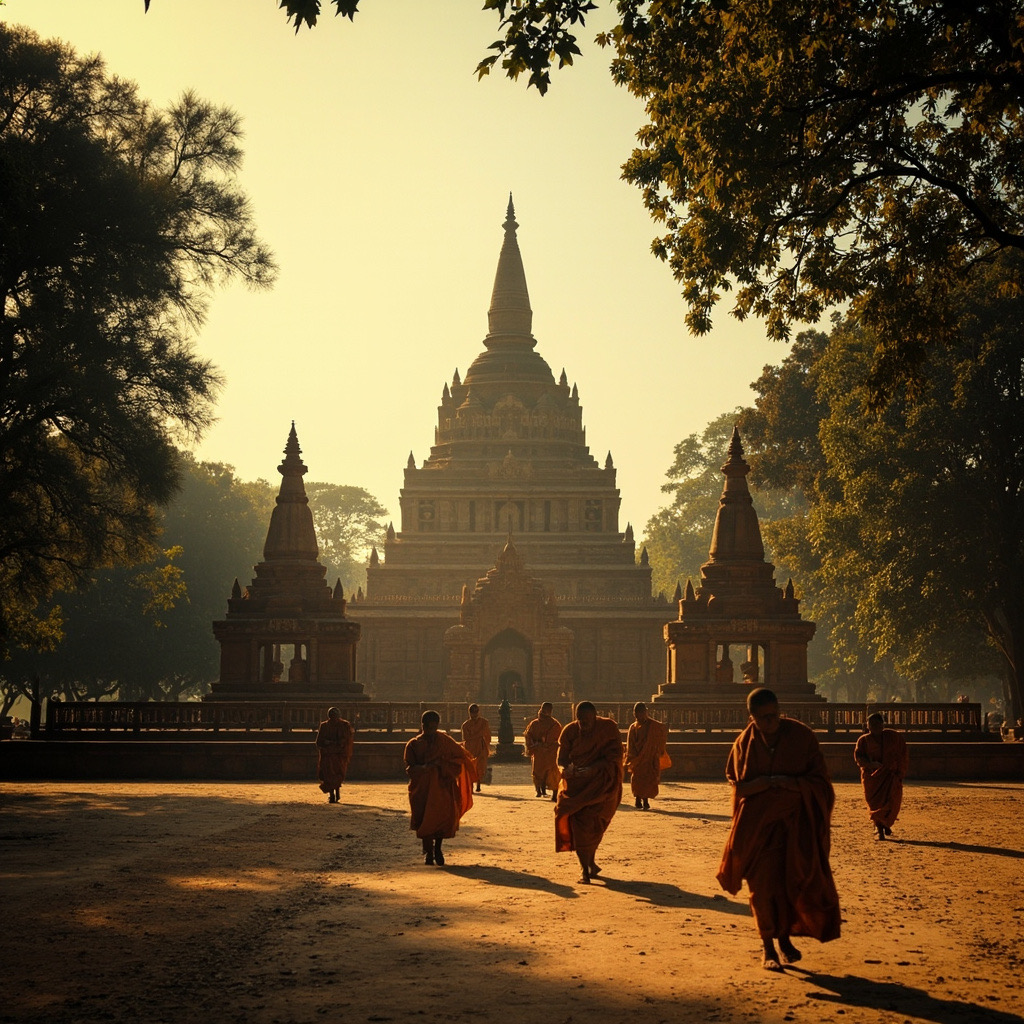
10km from Varanasi, a quiet park marks the place where Gautama Buddha turned the Wheel of Dharma for the first time — to an audience of five. It is one of Buddhism's eight sacred sites, and one of the most serene places in India.
Why it made the cut: I verified this tour in April 2025. The operator maintains high safety standards and local guide quality.
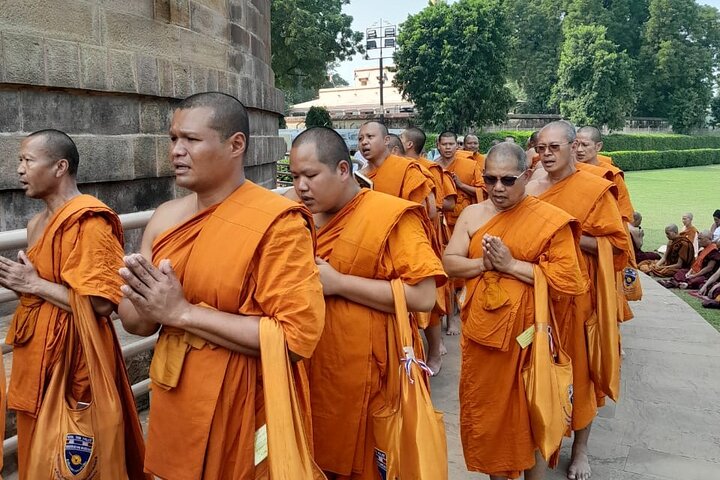
The drive from Varanasi to Sarnath takes 30–40 minutes by auto-rickshaw — less if traffic is light. You turn off the main highway onto a road flanked by dusty trees and small shrines, then arrive at a complex that is nothing like the chaos of the Varanasi ghats. Sarnath is quiet. Pigeons move across the grass. The Dhamek Stupa rises 43 meters above the tree line, its surface pocked by centuries. Buddhist monks in burgundy robes walk the paths. The deer that give the site its older name - Deer Park - are long gone, but the calm they symbolized persists.
For Buddhist pilgrims, Sarnath completes the essential circuit. The sequence is: enlightenment at Bodh Gaya (where Siddhartha became the Buddha), first teaching at Sarnath (where he set the Dharma in motion), and final passing at Kushinagar (where he died). Most organized Buddhist pilgrimage tours run all three in a single trip. If you are in India specifically for Buddhist sites, Sarnath is the hinge between the two defining moments — and a place worth sitting in for an hour after you've walked the circuit.
For non-Buddhist visitors, Sarnath is an introduction to one of history's most consequential religious figures. The site is not loud or demanding. You are not expected to pray. You can walk the Dhamek Stupa, sit near the Ashoka Pillar, visit the museum, and leave with a clear sense of what the Buddha taught and why this particular clearing in the forest mattered.
the best to visit is the early morning — between 7:30 and 10:00 AM - when the light is soft, the site is uncrowded, and the deer park atmosphere is most present. After 10:00 AM in summer the heat on the open Dhamek Stupa platform becomes intense.
What You Will See at Sarnath
Dhamek Stupa
The central monument. At 43 meters tall and 28 meters in diameter, it is the largest stupa at Sarnath. The current structure dates from the 5th century CE, built during the Gupta period, though it marks the exact spot where the Buddha gave his first teaching. The core of the mound may contain earlier deposits. Walk clockwise around the base — the Buddhist circumambulation direction - as monks do. The surface of the stupa is carved with decorative motifs that become clearer as you move around the structure.
Ashoka Pillar
Erected by Emperor Ashoka in the 3rd century BCE, this pillar originally stood about 12 meters tall. It was found in fragments in the 19th century and reassembled in its current form near the Dhamek Stupa. The lion capital — four back-to-back lions atop the pillar - became the model for India's national emblem. An inscription on the pillar records Ashoka's gifts to the site. It is one of the oldest surviving Buddhist monuments at Sarnath and one of the finest examples of Mauryan art.
Sarnath Archaeological Museum
The museum holds the collection of artifacts excavated at Sarnath since the 1830s. The standout piece is the Ashoka Pillar's lion capital, displayed inside. There are also Buddhist sculptures spanning centuries of iconography — from the early plain shalabhanjika figures to later ornate Pala-era bronzes. The museum's collection of Gupta-period Buddha images is considered one of the finest in India. Allow 60–90 minutes if you want to read the descriptions.
Hours: Saturday–Thursday, 10:00 AM–5:00 PM (last entry 4:15 PM). Closed Fridays and public holidays.
Entry fee: ₹25 for Indian nationals, ₹300 for foreign visitors (prices subject to change — verify at the site).
Mulagandha Kuty Vihara
The modern monastery temple at the eastern edge of the complex. Built in the 20th century, it is an active Buddhist worship site — monks gather here for morning and evening chanting. The interior is simple and calm, with walls decorated in Buddhist imagery. Non-Buddhists are welcome to enter quietly. The temple's bell tower offers a different vantage point over the Dhamek Stupa from above the complex.
Practical Information for Your Visite.
Getting There
Auto-rickshaw: The most practical option for solo pilgrims. From Varanasi Old City to Sarnath: ₹150–250 one way, 30–40 minutes. Agree on the fare before departing — do not expect the meter to be used. Book the same rickshaw to wait for 2 hours (₹200–300 extra) rather than finding a return ride.
Taxi: ₹400–600 for a round trip with 2 hours waiting. More comfortable in summer heat. Ola and Uber operate in Varanasi but auto-rickshaws are more consistently available for the Sarnath run.
Tour with transport: A Sarnath audio tour with pickup from your Varanasi hotel handles logistics in one booking. We recommend this if you are unfamiliar with the city.
Opening Hours
The Sarnath archaeological site is open daily. Hours are approximately 7:00 AM to 6:00 PM, though the exact timing shifts seasonally. The Dhamek Stupa platform is exposed — there is limited shade, on the southern face. Morning visits (before 10:00 AM) are markedly more comfortable from May through September.
The museum is open Saturday–Thursday, 10:00 AM–5:00 PM (last entry 4:15 PM), closed Fridays. Budget an extra 60–90 minutes for the museum if you want to do it properly.
What to Wear
Modest dress is expected. Loose, lightweight cotton in light colors is the most practical choice — temperatures in Varanasi reach 40°C+ in May and June, and the Sarnath complex has limited shade. A scarf or light shirt to cover your shoulders is useful. Footwear inside the complex is standard - you will not need to remove shoes as at Hindu temples.
Combining with Varanasi
The standard half-day Sarnath itinerary: depart Varanasi by 8:00–9:00 AM, spend 2–3 hours at the site and museum, return by 12:00–1:00 PM. This leaves the afternoon and evening free for the Varanasi ghats, a sunset boat ride, or the evening Ganga Aarti at Dashashwamedh Ghat.
If you are extending to a full India Buddhist circuit, the natural next stop after Sarnath is Bodh Gaya — the site of the Buddha's enlightenment, approximately 250km away by road or train. The Varanasi–Bodh Gaya journey takes 6–8 hours by road or 4–5 hours by train.
Getting There
Auto-rickshaw: The most practical option for solo pilgrims. From Varanasi Old City to Sarnath: ₹150–250 one way, 30–40 minutes. Agree on the fare before departing — do not expect the meter to be used. Book the same rickshaw to wait for 2 hours (₹200–300 extra) rather than finding a return ride.
Taxi: ₹400–600 for a round trip with 2 hours waiting. More comfortable in summer heat. Ola and Uber operate in Varanasi but auto-rickshaws are more consistently available for the Sarnath run.
Tour with transport: A Sarnath audio tour with pickup from your Varanasi hotel handles logistics in one booking. We recommend this if you are unfamiliar with the city.
Opening Hours
The Sarnath archaeological site is open daily. Hours are approximately 7:00 AM to 6:00 PM, though the exact timing shifts seasonally. The Dhamek Stupa platform is exposed — there is limited shade, on the southern face. Morning visits (before 10:00 AM) are markedly more comfortable from May through September.
The museum is open Saturday–Thursday, 10:00 AM–5:00 PM (last entry 4:15 PM), closed Fridays. Budget an extra 60–90 minutes for the museum if you want to do it properly.
What to Wear
Modest dress is expected. Loose, lightweight cotton in light colors is the most practical choice — temperatures in Varanasi reach 40°C+ in May and June, and the Sarnath complex has limited shade. A scarf or light shirt to cover your shoulders is useful. Footwear inside the complex is standard - you will not need to remove shoes as at Hindu temples.
Combining with Varanasi
The standard half-day Sarnath itinerary: depart Varanasi by 8:00–9:00 AM, spend 2–3 hours at the site and museum, return by 12:00–1:00 PM. This leaves the afternoon and evening free for the Varanasi ghats, a sunset boat ride, or the evening Ganga Aarti at Dashashwamedh Ghat.
If you are extending to a full India Buddhist circuit, the natural next stop after Sarnath is Bodh Gaya — the site of the Buddha's enlightenment, approximately 250km away by road or train. The Varanasi–Bodh Gaya journey takes 6–8 hours by road or 4–5 hours by train.
Frequently Asked Questions
Can non-Buddhists visit Sarnath?
Yes. Sarnath is open to all visitors regardless of faith background. The site is not a functioning temple — it is a heritage complex. Non-Buddhist visitors are welcome to walk the grounds, visit the museum, and observe the practices of Buddhist monks who worship there. There is no expectation of participation in rituals.
Is photography allowed at Sarnath?
Photography of the exterior of the Dhamek Stupa and the archaeological grounds is permitted with a regular phone or camera. Tripods and professional video equipment may require a permit from the Archaeological Survey of India. Photography inside the museum is restricted — look for the signs at the museum entrance. The interior of the Mulagandha Kuty Vihara is generally photography-free out of respect for worship in progress.
What is the connection between Sarnath and Bodh Gaya?
They are the two defining sites in the Buddha's life after his enlightenment. The Buddha attained enlightenment at Bodh Gaya in approximately 528 BCE, then traveled to Sarnath — then called Deer Park by the Hill of the Fallen Sages - to deliver his first teaching to his five original disciples. Together they form the core of the Buddhist pilgrimage circuit in India. Visiting both gives a complete picture of the Buddha's founding narrative: the awakening and the founding teaching.
How much time do I need at Sarnath?
A minimum of 2 hours to walk the Dhamek Stupa, see the Ashoka Pillar, and spend time in the museum. 3 hours is more comfortable and allows for the quieter moments the site rewards — sitting near the stupa, walking the Mulagandha Kuty Vihara, watching the monks. It is not a place to rush.
Sarnath Tours
selected tour options for Sarnath from Varanasi — including audio tour and private car options with hotel pickup.
Sarnath Audio Tour — Buddha's First Sermon Site
A self-guided audio tour of the Sarnath complex: Dhamek Stupa, Ashoka Pillar, Mulagandha Kuty Vihara, and the Archaeological Museum grounds. Download the app before you go, then explore at your own pace with commentary on the history and significance of each monument. Includes suggested route, estimated times, and key details the site signs don't cover.
Check Availability on Viator →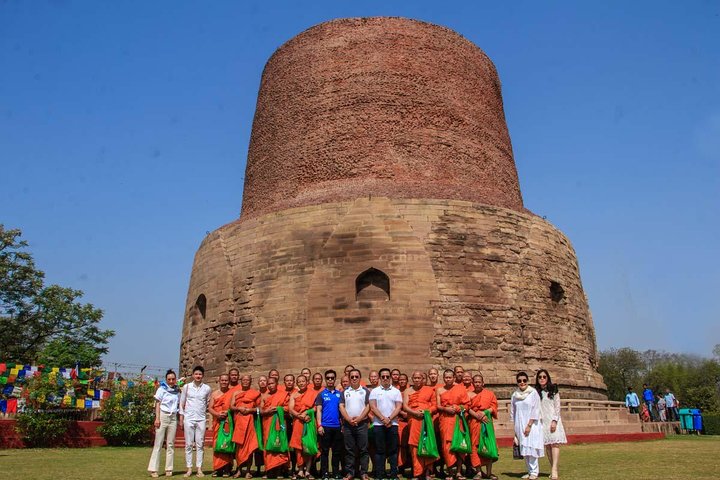
Varanasi Buddhist Sites Day Tour — Sarnath + Varanasi Temples
A full-day guided tour covering the Buddhist sites around Varanasi: Sarnath in the morning, then returning to the old city for the main ghat circuit, a brief temple visit, and the evening Ganga Aarti. Designed for pilgrim-level depth — your guide explains the Buddhist narrative at Sarnath and the Hindu context at each Varanasi stop. Includes hotel pickup, transport, and guide.
Check Availability on Viator →Buddhist Pilgrimage Cluster — India
Sarnath is the second site in our Buddhist India cluster, alongside Bodh Gaya (where the Buddha attained enlightenment) and Varanasi (the wider context for the trip). These three form the core of an India Buddhist pilgrimage.
Bodh Gaya
The site of Gautama Buddha's enlightenment under the Bodhi tree. The Mahabodhi Temple is the most important Buddhist pilgrimage site on earth, drawing monks and laypeople from every Buddhist tradition worldwide — Theravada, Mahayana, and Vajrayana alike.
Visit Bodh Gaya →Varanasi Hub
The oldest continuously inhabited city on earth and the holiest city in Hinduism. Varanasi is the starting point for the Buddhist circuit in India — the ghats, the temples, the evening Aarti, and the base for day trips to Sarnath and beyond.
Visit Varanasi →