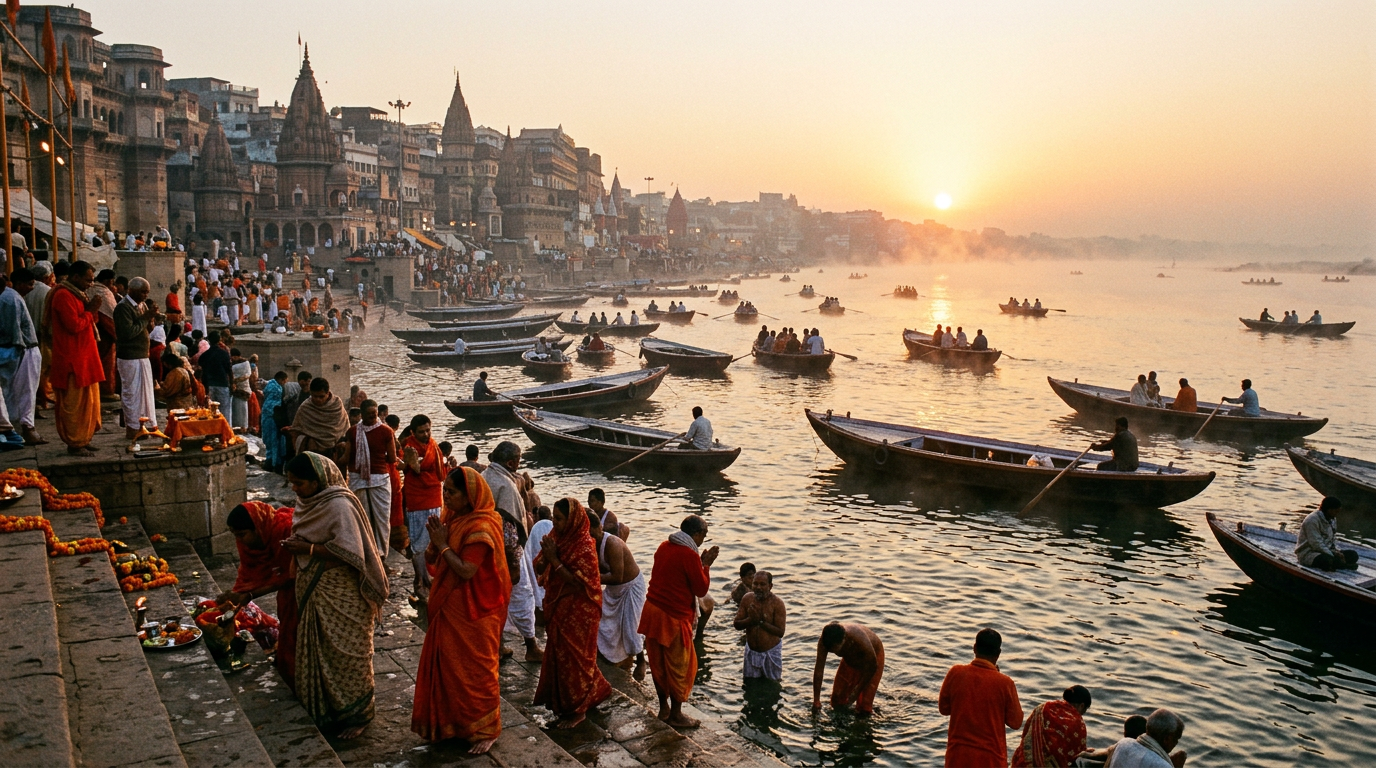
The first time I walked the full length of the Varanasi riverfront, from Assi Ghat in the south to Panchganga in the north, it took me four hours. Not because the distance is great — it is about 6.5 kilometres of stone steps and platforms — but because Varanasi does not separate the sacred from the mundane. Birth, death, prayer, commerce: it all happens on the same waterfront, and every hundred metres something stopped me. A body carried past on a bamboo bier. A wrestler oiling himself at an akhara. A priest reading a horoscope under a palm-leaf umbrella that has probably stood in the same spot for generations.
Guidebooks tend to list the ghats exhaustively, all 84 or 88 of them depending on who is counting, which is honest but not useful. Most are residential bathing steps with little to distinguish them. As a pilgrim, or as a traveller trying to understand why Hindus have come to this bend in the river for at least three millennia, you need perhaps ten. The city's riverfront is significant enough that India has placed it on UNESCO's World Heritage Tentative List, but the ghats are not a monument. They are a working religious landscape, and this guide treats them that way.
I have arranged the ten south to north, the direction I recommend walking, because it moves you from the quieter devotional ghats toward the ritual centre of the city and ends at its most layered site. If you are new to the city, read my broader Varanasi pilgrimage guide first for context on Kashi, moksha, and why dying here matters to Hindus.
The Southern Ghats: Where the City Breathes
1. Assi Ghat
The southernmost of the major ghats, at the confluence where the small Assi river once met the Ganges. Tradition holds that the poet-saint Tulsidas died here in 1623, and pilgrims performing the Panchatirthi Yatra — the circuit of five crossing-places — begin at Assi. It is also, frankly, where modern Varanasi relaxes: students from Banaras Hindu University, morning yoga classes, chai stalls. The Subah-e-Banaras ceremony at dawn is a recent invention (it began in 2014), but the sunrise itself is not, and Assi is the easiest place to board a boat without the crush of Dashashwamedh.
2. Tulsi Ghat
A few hundred metres north, and named for Tulsidas, who lived here in the late 16th century while composing the Ramcharitmanas — the Hindi retelling of the Ramayana that most North Indian Hindus know better than the Sanskrit original. His house still stands above the ghat, and his wooden sandals and a manuscript are kept there. The Ramlila performance tradition he founded, still staged in Varanasi every autumn, is inscribed on UNESCO's Representative List of Intangible Cultural Heritage. Tulsi Ghat is quiet most of the year. I sat here for an hour one January morning and shared it with two bathers and a dog.
3. Harishchandra Ghat
The smaller of the two cremation ghats, named for King Harishchandra, who in legend gave up his kingdom, his family, and finally his own dignity rather than tell a lie, and ended his trial working as a cremation-ground attendant on this spot. Some families consider it the older and more meritorious of the two burning ghats. It is less visited than Manikarnika and, in my experience, a more composed place to sit with the reality of what happens here. An electric crematorium was added in the 1980s; the wood pyres continue alongside it.
Skip this one — and Manikarnika below — if you know that open-air cremation will distress you. There is no shame in that, and the mourners owe you nothing. The ghats are not a test.
The Central Stretch: The Ritual Heart
4. Kedar Ghat
You cannot miss it: the Kedareshwar temple above the steps is painted in broad red-and-white vertical stripes, the marking of South Indian Shaiva tradition. The lingam inside is held to be a natural outcrop, self-manifested rather than installed, and the ghat draws a strong Bengali and Tamil pilgrim community. Kedar Ghat at 6 am is one of the best places on the river to watch ritual bathing done unselfconsciously, by people for whom it is simply Tuesday.
5. Munshi Ghat
Built in 1912 by Sridhara Narayana Munshi, a finance minister of the Nagpur estate, and later extended by the Darbhanga royal family — the massive Greco-Indian palace looming above it is now a hotel. Munshi has no major shrine and no famous ritual, which is exactly why I include it: it is a calm, uncrowded place to board a boat, take a breath between the intensity of Kedar and Dashashwamedh, or photograph the architecture of the riverfront without fifty other cameras in frame.
6. Dashashwamedh Ghat
The main ghat. The name means "ten-horse sacrifice," from the myth that Brahma performed the ashvamedha rite here ten times over. Whatever its origins, it is now the ceremonial centre of the riverfront, and every evening at sunset seven priests perform the Ganga Aarti — a synchronised offering of fire, incense, and conch blasts to the river as goddess. The ceremony in its current staged form is over a century old and happens daily, in every season, regardless of weather or crowd. I watched the aarti from a boat 50 metres out and it was the right call: from the water you see the whole line of flame-bearing priests at once, mirrored in the river, rather than the back of someone's head. I have written a full account in my Ganga Aarti guide, including where to sit if you prefer the steps.
7. Man Mandir Ghat
Just north of Dashashwamedh, built around 1600 by Raja Man Singh of Amber (Jaipur), whose sandstone palace still fronts the river with some of the finest carved balconies in the city. A century and a quarter later, Sawai Jai Singh II added a Jantar Mantar on the roof — a masonry observatory of the same family as the famous ones in Jaipur and Delhi, with instruments for tracking the sun and stars. It is open to visitors for a small fee and almost always empty. The juxtaposition is very Banarasi: precise 18th-century astronomy stacked directly above the oldest continuous religious theatre on earth.
The Northern Ghats: Death and the Long Memory
8. Manikarnika Ghat
The great cremation ground, the mahashmashana. Hindu tradition holds that the fires here have not gone out in living memory — the sacred flame kept by the Dom community is said to be thousands of years old, and cremation on this spot is attested in texts going back well over a millennium, with the site's ritual use likely far older. To die in Kashi and be cremated at Manikarnika is, for many Hindus, to attain moksha: release from the cycle of rebirth. Some 80 to 100 cremations take place daily. The atmosphere is not mournful in the way outsiders expect; it is brisk, matter-of-fact, wood-smoke and logistics. Watch from a respectful distance, keep your camera down — photography of the pyres is genuinely forbidden — and refuse anyone offering a "special viewing area" in exchange for a donation toward firewood. That request is a script, and the money does not buy wood.
9. Scindia Ghat
Immediately adjoining Manikarnika, and my favourite illustration of the riverfront's instability. When the ghat was rebuilt around 1830 by the Scindia rulers of Gwalior, its masonry proved so heavy that the whole structure began sliding into the river, and a Shiva temple at the water's edge now stands permanently tilted, half-submerged, like a ship going down at anchor. Above the ghat lies Siddha Kshetra, a warren of lanes dense with shrines, where Agni, god of fire, is said to have been born. After the smoke of Manikarnika, Scindia is oddly serene.
10. Panchganga Ghat
The northern anchor of the pilgrim circuit, where five rivers — the Ganga, Yamuna, Sarasvati, Kirana, and Dhutapapa — are believed to converge, the latter four invisibly. This was where the 16th-century weaver-poet Kabir is said to have tricked the Brahmin teacher Ramananda into initiating him, by lying on the steps in the pre-dawn dark. Rising directly above the ghat is the Alamgir Mosque, built in the 17th century under Aurangzeb on the foundations of the great Bindu Madhava temple. Hindus still worship at a small replacement shrine beside it; Muslims still pray in the mosque above. Five hundred years of contested, shared, stubborn coexistence, stacked vertically on one staircase. Nowhere else on the river compresses the city's history so tightly. During Kartik (October–November), pilgrims hang akash-deep — sky lamps in baskets on tall bamboo poles — to light the way for ancestors.
Practical Notes from My Notebooks
- When to go: October through March. In the monsoon (July–September) the river swallows the lower steps, the riverside walk breaks up, and boats are often grounded by the current. My most recent walks were in January: cold mornings, fog on the water, perfect.
- Time of day: Dawn for the bathing ghats (Assi, Kedar, Panchganga), dusk for Dashashwamedh. The dead hours of midday belong to the heat and the touts.
- Boat negotiation: Agree on price, duration, and route before boarding, and confirm whether the price is per person or per boat — that ambiguity is the oldest trick on the river. A private rowboat for an hour ran me 800–1,500 rupees depending on season and my patience. The boatman rowed silently as the sky shifted from black to grey to pale orange, and that silence is the argument for a rowboat over a motorboat.
- Photography: No photographs of the cremation pyres at Manikarnika or Harishchandra, full stop. Ask before photographing bathers, especially women. Wide shots of the riverfront from a boat offend no one.
- Dress and conduct: Shoulders and knees covered is a reasonable baseline. Remove shoes before stepping onto temple platforms. Do not step over anyone's puja items laid out on the steps.
- Footing: The steps are steep, uneven, and slick with river mud near the waterline. If stairs are difficult for you, know that the ghats are essentially one long staircase — a boat is the accessible way to see them, and the lanes above are no easier.
Boat Tours I Would Actually Point You Toward
You can arrange everything below yourself on the steps, and if you enjoy negotiating in Hindi at 5 am, you should — skip these entirely. I recommend a booked tour in two cases: your first morning in the city, when the riverfront is disorienting, or when you want a guide who can name what you are looking at. Booking through these links costs you nothing extra and supports this site.
Varanasi Sunrise Boat and Ganga Aarti Private Tour
The full arc in one day: a rowboat past the ghats at first light, then a reserved position for the evening Ganga Aarti at Dashashwamedh. This is the one I would suggest for a first visit, because it pairs the two experiences this guide is built around and puts a guide beside you at Manikarnika, where context matters most. It is private, so it costs accordingly; travellers on a tight budget should take the shared morning boat below and watch the aarti free from the steps.
Check availability and current price on ViatorVaranasi Evening Ganga Aarti Tour
Focused on the Dashashwamedh aarti alone: a walk through the old-city lanes, then the ceremony itself. Worth it if you have one evening and want the sequence explained rather than merely witnessed. Not for you if crowds wear you down — the aarti draws thousands nightly, and no tour changes that. If you would rather watch from the water, book a boat instead; my aarti guide weighs the two.
Check availability and current price on ViatorVaranasi Morning Boat Tour (Rowboat)
The simple option: a rowboat at dawn along the stretch from Assi toward Manikarnika, which covers most of the ten ghats in this guide from the water. A rowboat, not a motorboat, which is the detail I care about — you hear the temple bells and the bathers instead of an engine. This is the budget-sensible pick, and honestly sufficient for many travellers. My notes on what to look for from the water are in the sunrise boat tour guide.
Check availability and current price on ViatorFrequently Asked Questions
How many ghats are there in Varanasi, and do I need to see them all?
More than 80, along roughly 6.5 kilometres of riverfront. You do not need them all; most are residential bathing steps. The ten in this guide carry most of the city's ritual weight, and a slow walk from Assi to Panchganga passes every one in two to three hours.
Can non-Hindus visit the cremation ghats?
Yes. Manikarnika and Harishchandra are open to all, and a quiet, respectful presence at a distance is accepted. Photography of the pyres is forbidden. Decline anyone offering a paid "viewing platform" — it is a standard solicitation, not a custom.
What time is the Ganga Aarti at Dashashwamedh Ghat?
Shortly after sunset — around 6:45 pm in winter, 7:00 pm in summer — lasting about 45 minutes, every evening of the year. Arrive an hour early for the steps, or watch from a boat, which is what I did and would do again.
How much should a boat ride cost?
At my last visit: 150–300 rupees per person for a shared sunrise rowboat, 800–1,500 rupees for a private one, for about an hour. Fix the price, route, duration, and whether it is per person or per boat before you board.
Is it safe to walk the ghats alone at dawn?
I did, repeatedly, and felt safe — the riverfront is busy with bathers and priests well before sunrise. The realistic hazard is the footing: steep, uneven, wet stone. Solo women should expect attention but, in my experience, little beyond it.
When is the best season to visit?
October to March. The monsoon submerges the lower ghats and halts most boat traffic. If you can plan around Dev Deepawali in November, when the ghats are lit with oil lamps, do — but book lodging months ahead.
Disclosure: Faith Pilgrimage participates in the Viator affiliate programme. If you book a tour through links on this page, we may earn a commission at no additional cost to you. This never determines what I recommend — where the self-arranged option is better, I say so above.