The Pilgrim's Guide to Jerusalem
Jerusalem contains sacred sites for three faiths. This guide is written for all of them — Jewish, Christian, and Muslim pilgrims, with what you need to know before you arrive.
Why it made the cut: I verified this tour in June 2024. The operator maintains high safety standards and local guide quality.
Jerusalem resists easy description. It is a city of roughly 900,000 people, a contested capital, a UNESCO World Heritage site, a place of intense political reality, and, for Jews, Christians, and Muslims, one of the most significant places in human spiritual history. I recommend 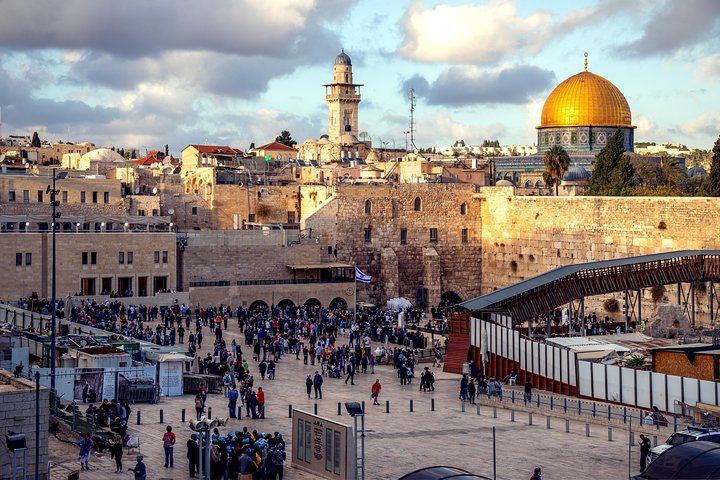 browsing guided tours of Jerusalem before you arrive — the Old City is dense and a knowledgeable guide saves hours of wrong turns. Whatever brings you here, the city will ask something of you. This guide tries to help you arrive prepared.
Each section below covers a specific sacred site or ritual area. Read them in order or jump to what matters most to you. If you are coming as a Jewish pilgrim, start with the Western Wall. If Christian, start with the Church of the Holy Sepulchre. If Muslim, start with Al-Aqsa and the Dome of the Rock. But know that in Jerusalem, all three traditions occupy the same few square kilometers, you will likely encounter all of them regardless of which site is your primary destination.
The Western Wall (Kotel)
The Western Wall is the last remnant of the Second Temple platform, built by Herod the Great and destroyed by Rome in 70 CE. It is the most visited site in the Jewish world and has been a place of continuous Jewish prayer for centuries, since the destruction, Jews have gathered here to mourn the loss of the Temple and to pray toward the place where it stood.
For a Jewish pilgrim, the Western Wall is not just a historic site. It is a place of active religious practice. On Shabbat and Jewish holidays, hundreds or thousands of people gather here. On ordinary days, there are hundreds of people at any given hour. The atmosphere is reverent and varied, people praying from texts, families celebrating bar mitzvahs, individuals in quiet conversation with God.
What to expect: You approach the Western Wall plaza through a security checkpoint. Bags are checked. The plaza itself is divided, the main section to the right (as you face the wall) is the men's section, and to the left is the women's section. Both are open to all visitors. On the wall itself, people leave notes in the cracks between the stones, a practice that has continued for centuries.
Dress code: Shoulders and knees covered for everyone. This is strictly enforced at the Western Wall, if you are not dressed appropriately, you will be given something to wear at the entrance. Men are required to wear a head covering (a kippah is provided at the entrance). Women do not need to cover their heads but many choose to.
Best time to visit: Early morning (before 8am) is quietest. Late afternoon until sunset is the most atmospheric. On Shabbat (Friday evening after sunset through Saturday evening) the Western Wall is filled with thousands of worshippers, powerful to witness but very crowded.
Al-Aqsa Mosque and the Dome of the Rock
Al-Aqsa Mosque is the third holiest site in Islam, after Masjid al-Haram in Mecca and the Prophet's Mosque in Medina. It is located on the Temple Mount (Har al-Aqsa in Arabic, Har HaBayit in Hebrew), which is also the site of the Biblical Temple and the location Jews consider holiest in the world. The relationship between these two traditions' sacred geography is at the heart of Jerusalem's complexity.
The Dome of the Rock is the oldest surviving Islamic monument in the world. Built in 691 CE by Caliph Abd al-Malik, its golden dome has become one of the most recognizable images in the world. The rock at its center is believed by Muslims to be the place from which the Prophet Muhammad ascended to heaven during the Night Journey (Isra and Mi'raj). The interior is covered in some of the oldest Islamic geometric tilework in existence.
Access for non-Muslim visitors: Al-Haram al-Sharif (the Temple Mount platform) is managed by the Jordanian Waqf. Non-Muslim visitors can access at specific times, which vary by day and season. You enter through the Gate of the Moors (Bab al-Maghariba) on the western side, adjacent to the Western Wall plaza. Times are posted at the gate. The Dome of the Rock interior is open to non-Muslim visitors at specific hours outside prayer times, confirm with your guide on the day.
Dress code: For women: long dress or trousers, long top covering arms and torso, head scarf. For men: long trousers (not shorts), shirt covering shoulders. No special footwear requirements but you will need to remove shoes before entering Al-Aqsa Mosque ( Shoe covers or plastic bags are sometimes provided; bring your own socks in case).
What it feels like: The Al-Aqsa compound is unexpectedly large, it can hold hundreds of thousands of people. On a quiet morning, the sense of space and light is striking. On Fridays and during Ramadan, it is one of the most densely populated prayer spaces in the world.
The Church of the Holy Sepulchre
The Church of the Holy Sepulchre marks the site where, according to Christian tradition — Jesus was crucified, buried, and resurrected. The current building is a 12th-century reconstruction, though the site itself has been Christian since the 4th century when Empress Helena (mother of Emperor Constantine) identified it. The church is shared among six Christian denominations - Roman Catholic, Greek Orthodox, Armenian Orthodox, Syrian Orthodox, Ethiopian Orthodox, and Coptic Orthodox, each responsible for specific sections, chapels, and daily rituals.
For a Christian pilgrim, walking into this church is walking into the geography of the Gospel. The 4th Station (the finding of the true cross) is in one corner. The 10th Station (the stripping of Jesus's garments) is at another. The Edicule, the small stone chapel that marks the traditional site of the tomb, sits at the center. The Stone of Anointing just inside the entrance is where Jesus's body was prepared for burial.
What to expect: The church is dark inside, it was built on top of a tomb, and the architecture reflects that. Candles are the primary light source. The crowds are real, around the Edicule and the Stone of Anointing. The smell of incense is heavy. Each denomination has its own daily prayer schedule, at certain hours, several denominations may be singing or praying in different parts of the church simultaneously.
The Edicule: The small chapel at the center of the church that marks the tomb was severely damaged in a 2026 fire and is undergoing restoration. Access may be restricted or different from what previous pilgrims describe. The faithful queue for an hour or more to enter the Edicule, for many, the queue itself is part of the pilgrimage.
Dress code: Covered shoulders and knees are expected. A shawl is useful, some sections are noticeably cold. This rule is less strictly enforced than at Jewish or Muslim sites, but dressing respectfully is part of showing up as a pilgrim rather than a tourist.
The Via Dolorosa
The Via Dolorosa, the Way of Suffering, traces the path Jesus is believed to have walked from his trial to his crucifixion, carrying the cross. The route is marked by 14 stations, beginning near the Lion's Gate (St. Stephen's Gate) in the Muslim quarter and ending at the Church of the Holy Sepulchre. The tradition of walking this path as a devotional practice dates to the earliest centuries of Christian pilgrimage.
Which stations are biblically grounded vs. tradition-based: The first station (Jesus is condemned) and the last stations (crucifixion, burial, resurrection) correspond to Gospel accounts. Stations 4 through 9 (Jesus meets his mother, Simon of Cyrene carries the cross, Veronica wipes his face, Jesus falls the second and third times, Jesus is stripped) are based on medieval tradition rather than specific biblical accounts. This is not hidden, it is documented and discussed openly by guides and historians. For a pilgrim, the distinction matters less than the act of walking.
What it is like: The Via Dolorosa runs through a densely populated neighborhood. You are walking on the same stone streets that have been walked for centuries, but the route is interrupted by shops, markets, and daily life. On Friday mornings, a formal procession led by Franciscans walks the entire route, this is the most traditional and most crowded way to walk it. At other times, you can walk it more privately.
The Mount of Olives
The Mount of Olives is a ridge east of the Old City, separated from it by the Kidron Valley. For Jews, it is one of the most significant burial sites in the world, the ancient Jewish cemetery here has been in continuous use for 3,000 years, and it is believed that the Messiah will arrive here when he comes. For Christians, the Mount of Olives is where Jesus taught his disciples, where he prayed before his arrest, and from which he ascended to heaven after the resurrection.
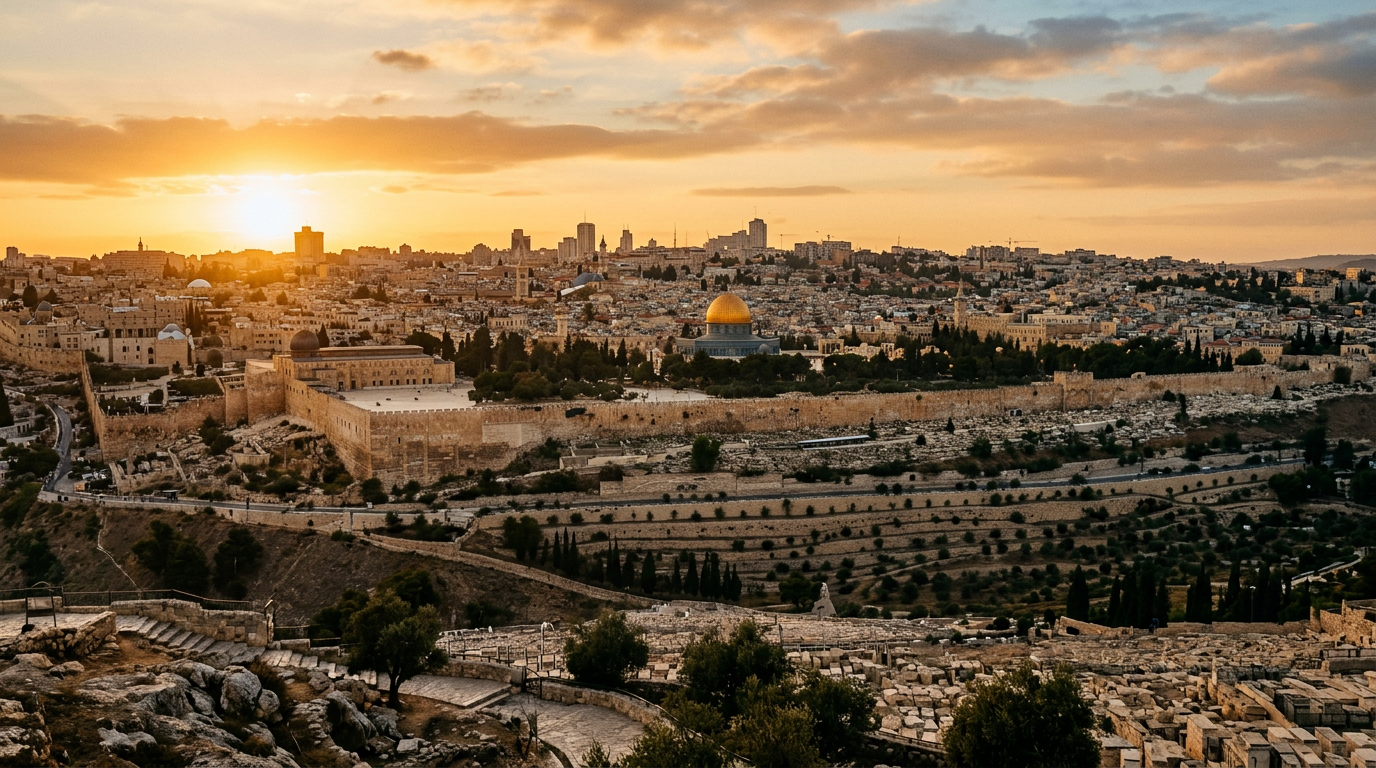
The view from the Mount of Olives over the Old City at golden hour is one of the most painted and photographed views in the world, and it is still remarkable in person. You are looking at the same city that artists depicted centuries ago, and the Golden Dome of the Rock still catches the last light of day in a way that explains exactly why it was painted the way it was.
Key sites: The Chapel of the Ascension (marking where Jesus ascended to heaven), the Church of All Nations at Gethsemane (built over the rock where Jesus prayed), the Tomb of the Virgin Mary (carved into the rock face below the Mount of Olives), and the Garden of Gethsemane (still planted with ancient olive trees, some of which may date to the time of Jesus).
Getting there: The walk from the Old City to the Mount of Olives takes about 15 minutes through the Lion's Gate and down the road that curves around the eastern side of the city walls. The path is steep in places. Allow 20–30 minutes to walk from the Western Wall to the Garden of Gethsemane.
Bethlehem and the Shepherds' Fields
Bethlehem is a 15-minute drive from Jerusalem's city center, through the separation barrier that defines the boundary between Jerusalem and the West Bank. For Christian pilgrims, this is the birthplace of Jesus, the site identified by the Church of the Nativity, built in the 4th century over the traditional birthplace cave, and one of the oldest continuously operating churches in the world.
The Church of the Nativity is managed jointly by the Latin (Roman Catholic) and Greek Orthodox churches. The exact spot of the birth is marked by a star in the floor of the Grotto of the Nativity, readable in multiple languages. Below the main church is the Grotto of St. Jerome, where Jerome translated the Bible into Latin (the Vulgate) in the 4th century.
The Shepherds' Fields, the fields outside Bethlehem where the angel announced the birth to the shepherds, are in the care of the Franciscan order. The site is a quiet garden with a small chapel. On a quiet morning, it is one of the most peaceful places in the Bethlehem area.
What to be aware of: Bethlehem is in the West Bank and requires passing through an Israeli checkpoint. This is not difficult, most pilgrims pass through without incident, but it adds time and requires carrying your passport. The city itself is a working Palestinian city with markets, traffic, and daily life. The church is not the only thing there.
How to visit respectfully: Arrive early in the day (before 10am) to avoid the tour bus crowds. Go to the Shepherds' Fields first, then the Church of the Nativity. Be present in the city, not just the church — Bethlehem is a Palestinian city and its pilgrims should know it as such.
Frequently Asked Questions
What is the dress code for visiting sacred sites in Jerusalem?
For the Western Wall: shoulders and knees covered for everyone. For Al-Aqsa Mosque: women cover everything except face and hands; men cover from navel to knee. For the Church of the Holy Sepulchre: covered shoulders and knees are respectful. Bring a scarf or shawl, it can be cold inside some buildings and you may need to cover at multiple sites in one day.
How much time should I allow for a Jerusalem pilgrimage?
A single day is enough to cover the Old City essentials. But most pilgrims who come with genuine spiritual intent want two to three days, one for the Old City, one for the Mount of Olives and Bethlehem, one for rest and unstructured time in the places that called them most.
What is the Temple Mount access situation?
Al-Haram al-Sharif is managed by the Jordanian Waqf. Non-Muslim visitors can access at specific times, which vary by day and season. The Dome of the Rock interior is occasionally open to non-Muslim visitors outside prayer times. Check with your guide on the morning of your visit for current conditions.
Can I visit the Western Wall and Al-Aqsa in the same day?
Yes. The Western Wall plaza and the Al-Aqsa compound are physically very close, about 5 minutes' walk from the Western Wall to the Al-Aqsa gate. It is possible to visit both in one morning. The experience of each is quite different, but they are close enough to combine.
What should I bring to the Western Wall?
A note to place in the wall cracks if that is meaningful to you (small paper is better than large, the wall guards are strict about size). A kippah is provided at the entrance if you need one. Comfortable shoes, you will walk a lot and the stone surfaces are uneven.
Is Jerusalem safe?
Jerusalem is a city with a complex political reality. For most pilgrims, the experience is deeply meaningful and the day-to-day safety is not different from any major urban center. We provide a pre-departure briefing covering current conditions, areas to avoid, and the practical realities of moving through the Old City. We do not minimize this, we address it directly. If you are traveling as a pilgrim rather than a tourist, you will find that the city responds differently to you.