I first walked the Via Dolorosa in March 2018, on a cold Thursday morning that smelled of cardamom coffee and wet limestone. I had read about it for years before I came — the fourteen Stations of the Cross, the route Christian tradition holds that Jesus walked from Pilate's judgment to the tomb. Reading it and walking it are not the same. The route does not begin at a grand gate or a visitor centre. It begins at a Muslim boys' school, the Umariya, built over the site tradition assigns to the Antonia Fortress, and if you are not paying attention you will walk straight past the First Station without knowing you passed it.
What follows is what I have learned across several walks, the last of them in April 2022, when I spent nine days in the Old City moving slowly through the Christian, Muslim, Armenian, and Jewish quarters. I write as someone who studies these routes rather than someone selling them. I will tell you where the path is confusing, where I made mistakes, and where I would spend my time differently now.
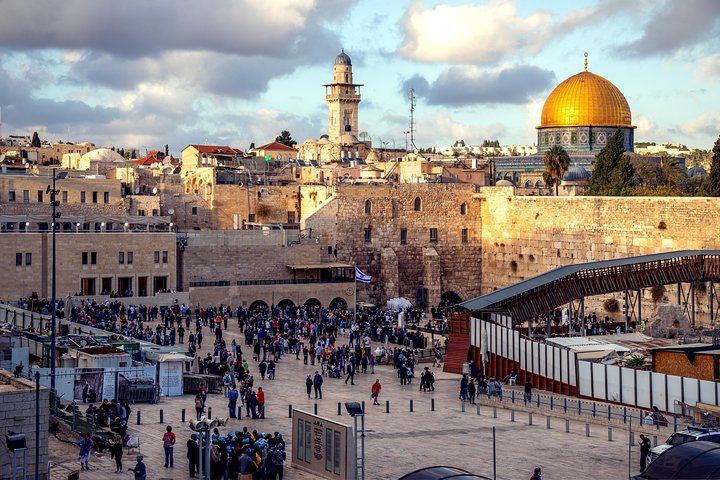
The Old City is roughly one square kilometre inside sixteenth-century Ottoman walls, and it is inscribed on the UNESCO World Heritage list. Within those walls, three faiths keep their holiest ground within a few hundred metres of one another. The Via Dolorosa threads through the middle of that density, and understanding the geography — which quarter you are in at each moment — changes how you read the walk.
Walking the Via Dolorosa — Station by Station
The route is about 600 metres end to end. On paper that is a ten-minute stroll. In practice it took me closer to two hours the first time, because the lanes are crowded, the stations are marked with small Roman numerals that are easy to miss, and I kept stopping to reconcile what I was seeing with what I had read.
Stations One through Nine run through the Muslim Quarter. This surprises many Christian pilgrims, who expect the whole route to feel Christian. It does not. You walk past spice sellers, butchers, children in school uniforms, and men carrying trays of bread on their heads. The devotional weight of the walk sits inside an ordinary working market. I found this arrangement moving rather than jarring — the sacred and the daily pressed together, the way they must have been on the original day.
Station One, where Pilate condemned Jesus, is inside the courtyard of the Umariya school. On weekdays it is closed to visitors during school hours, so you often stand in the street and read the plaque on the wall. Station Two, across the road at the Franciscan Church of the Flagellation and the Chapel of the Condemnation, is where the route becomes tangible — the Franciscans have kept this complex since the fourteenth century, and the courtyard is quiet enough to gather your thoughts.
Stations Three and Four come close together on the left as you descend, marked by small chapels — the Armenian Catholic Patriarchate holds these. They are easy to miss because the doorways are modest and the numerals are small. Station Five, where Simon of Cyrene was made to carry the cross, sits at the corner where the route turns and begins to climb. There is a worn spot on the wall that pilgrims have touched for centuries.
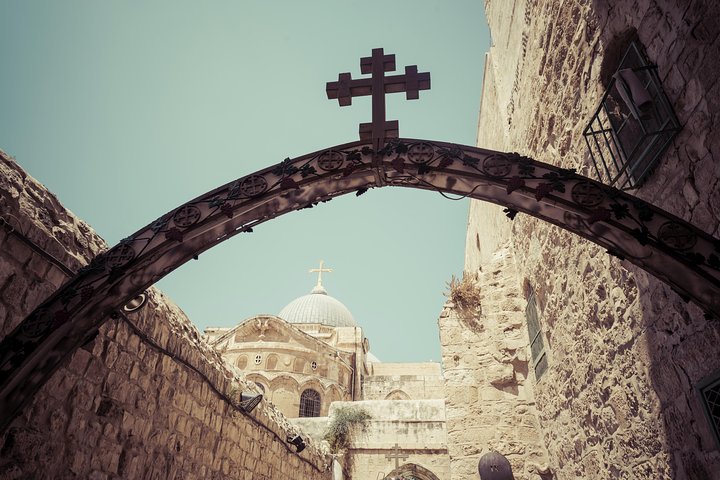
Station Six (Veronica) and Station Seven (the second fall) are, in my experience, the two most commonly missed. Six is a small door on the left with a column set into the wall; Seven is at a busy junction where the Via Dolorosa crosses a market street. Station Eight, where Jesus spoke to the women of Jerusalem, is marked by a stone cross set in the wall of a Greek Orthodox monastery — you have to look up and to the left. Station Nine requires a small detour up a flight of steps to the Ethiopian and Coptic section on the roof of the Holy Sepulchre complex.
If you want the first nine stations to make sense on a first visit, a guided walk earns its cost here. This is the part of the route I would not attempt to narrate to a friend from memory — the turns are subtle.
Jerusalem Walking Tour: In the Footsteps of Jesus
Check availability →Stations Ten through Fourteen are all inside the Church of the Holy Sepulchre. This is the second surprise for many pilgrims: the last third of the route is not on the street at all. The final five stations — the stripping of garments, the nailing to the cross, the death, the removal from the cross, and the burial — are stacked vertically inside one building, on and around the rock of Golgotha and the tomb.
Skip this if: you have mobility issues. The Via Dolorosa involves steep, uneven stone steps, narrow lanes with no handrails, and worn stone that turns slick in the rain. The final stations inside the church require climbing a steep, tight staircase up to Golgotha. There is no step-free version of the full route.
The Church of the Holy Sepulchre — Inside Christianity's Holiest Site
Nothing prepared me for the inside of this church. I had expected a single, unified sanctuary. Instead I found a building shared, argued over, and jointly held by six Christian denominations — Greek Orthodox, Roman Catholic (through the Franciscans), Armenian Apostolic, Coptic Orthodox, Syriac Orthodox, and Ethiopian Orthodox. The arrangement that governs who controls which chapel, altar, and hour of prayer is called the Status Quo, and it has been fixed in its current form since 1852, under an Ottoman decree. Nothing may be moved without the agreement of all parties, which is why a wooden ladder has sat below a window ledge since the eighteenth century — no single community may take it down.
The detail I find most telling is the key. For centuries the responsibility of opening and closing the church has been held by two Muslim families of Jerusalem. The Nuseibeh family holds and turns the key; the Joudeh family has traditionally kept it. Every morning a member of the Nuseibeh family unlocks the door, and every night locks it again.
Inside, two structures anchor the visit. Golgotha, the rock of the crucifixion, is up the steep stairs to the right of the entrance. The Edicule, the small shrine over the tomb, stands under the rotunda. The line for the Edicule is the single longest wait on the whole pilgrimage. I have waited more than two hours on a Saturday. Time your visit for early morning, close to opening, or for the middle of a weekday afternoon when tour groups have moved on to lunch.
Best of Jerusalem Full-Day Tour from Jerusalem
Check availability →Not for travelers who prefer independent exploration: a guided full-day tour keeps to a group pace and a fixed sequence. If your instinct is to sit for an hour in one chapel, or to double back to a station you missed, book the walk-in visit instead and go at your own rhythm.
Beyond the Old City — Mount of Olives, Gethsemane, and Bethlehem
The Via Dolorosa and the Holy Sepulchre are the centre of the Christian pilgrimage, but they are not the whole of it. Three sites outside the church walls belong on any serious itinerary.
The Mount of Olives rises east of the Old City, across the Kidron Valley. I climb it early, before the heat. From the top, near the Church of the Ascension, you look back across the valley to the Old City wall and the gold of the Dome of the Rock, with the sealed Golden Gate directly opposite. It is the clearest single view of Jerusalem's sacred geography I know.
At the foot of the mount lies the Garden of Gethsemane, beside the Church of All Nations. The garden holds eight ancient olive trees. Radiocarbon and genetic work published in the past decade suggests parts of the trunks may be around 900 years old. The trees are gnarled, silver-leaved, and unmistakably old. I have sat on the low wall opposite them at dawn when the garden was empty, and it is the quietest devotional moment the pilgrimage offers.
Bethlehem and the Church of the Nativity sit about ten kilometres south, in the West Bank, under Palestinian Authority control. You cross a checkpoint to reach it, which means bringing your passport. The Church of the Nativity, included on the UNESCO World Heritage list and promoted by the Israel Ministry of Tourism among Christian sites, is built over the grotto tradition marks as the birthplace. You enter through the Door of Humility, a doorway so low you must stoop, and descend to the silver star set in the floor of the grotto. A combined Jerusalem-and-Bethlehem day tour handles the checkpoint crossing and the transport, which is the practical reason most pilgrims book one rather than arranging their own taxi.
Full-Day Trip of Jerusalem and Bethlehem
Check availability →I will be honest about that last tour: its rating sits lower than the other two, and the reviews I have read point to long checkpoint waits and rushed time at each site. I include it because the combined logistics are genuinely useful for a one-day visitor, but if you can spare a second day, I would visit Bethlehem separately and unhurried rather than compressed into a single circuit.
When Things Go Wrong
My first walk went wrong in three ordinary ways, and I share them because no guidebook told me in advance.
I arrived too late. I reached the church at 4:30 in the afternoon in March, assumed I had hours, and found the line for the Edicule already an hour deep, with the closing routine beginning before I reached the front.
I came in the wrong gate. There are several gates in the Old City wall, and the nearest one to the start of the Via Dolorosa is the Lions' Gate (also called St Stephen's Gate) on the eastern side. I entered by the Damascus Gate my first time, which is closer to the middle stations, and spent forty minutes walking backwards through the market to find Station One.
I hit closed sections. Individual chapels along the route keep their own hours, and Station One's courtyard is shut during school. On Sundays and major feast days some Greek Orthodox and Armenian areas inside the church are given over to liturgy and are not open for casual visits.
And there are security checks and long lines. During periods of tension, gates close and streets are restricted with little notice. I have twice found a lane I planned to use simply blocked. Build slack into the day, carry water, and do not schedule the pilgrimage so tightly that one closure collapses the whole plan.
What I'd Do Differently
After several visits, here is the advice I give friends who ask me before they go:
- Start at opening. Reach the Lions' Gate for the church's morning opening and walk the stations before the tour groups arrive. The difference in crowds between 6 a.m. and 10 a.m. is enormous.
- Enter by the Lions' Gate, not the Damascus or Jaffa gates, so the fourteen stations run in sequence rather than out of order.
- Take a guide for the first nine stations, then go independent inside the church. The street stations are where narration helps most; the church rewards slow, unguided time.
- Dress for a working religious site. Shoulders and knees covered, in the church and in Bethlehem. I carry a light scarf year round.
- Give Bethlehem its own half-day if you possibly can, and carry your passport for the checkpoint. Combining it with Jerusalem in one circuit rushes both.
- Visit the Mount of Olives and Gethsemane at dawn. The view and the garden are worth the early alarm, and both are near-empty before eight.
- Check the liturgical calendar before you fix a date. Feast days close sections to visitors and fill the streets. Friday afternoons bring the procession.
- Do not over-schedule. Closures and security checks are routine. Plan for the pilgrimage to take a full day and leave the evening open.
I have walked this route enough times now that I could find Station Six with my eyes closed, but the first walk is the one I remember most clearly — the confusion, the missed turns, the shock of finding the last stations indoors. If this guide spares you my mistakes, it has done its work. Walk slowly. The 600 metres are short; what they hold is not.
Frequently Asked Questions
How long does it take to walk the Via Dolorosa?
The walk itself covers about 600 metres and takes 30 to 45 minutes if you move steadily. Add the Church of the Holy Sepulchre, where the final five stations sit, and you should plan for two to three hours in total.
Do I need a guide to walk the Via Dolorosa?
No — the route is signposted with Roman numerals and you can walk it alone. A guide is most useful for the first nine stations, which run through the crowded Muslim Quarter lanes and are easy to miss on a first visit.
What time does the Church of the Holy Sepulchre open?
The church opens around 5 a.m. in summer and 4 a.m. in winter, closing around 9 p.m. in summer and 7 p.m. in winter. Hours shift with the season and the liturgical calendar, so confirm before you go and arrive early to avoid the longest lines.
Can I visit Bethlehem on the same day?
Yes. Bethlehem sits about ten kilometres south, in the West Bank, and a tour or taxi handles the checkpoint crossing. Bring your passport. If you can spare the time, I would give Bethlehem its own half-day rather than compress it into a single circuit.
Which day is best for the Via Dolorosa?
Friday afternoon carries the Franciscan procession, which is moving to witness but very crowded and hard to move through independently. For a quieter walk, start early on a weekday morning and check the liturgical calendar for feast-day closures.
Is the Via Dolorosa accessible for those with mobility issues?
Only partly. The route involves steep, uneven stone steps and narrow lanes without handrails, and the final stations inside the church require climbing a steep, tight staircase up to Golgotha. There is no step-free version of the full route.