Disclosure: This page contains affiliate links to Viator. If you book through them, Faith Pilgrimage earns a commission at no extra cost to you. My assessments are my own.
Skip to main content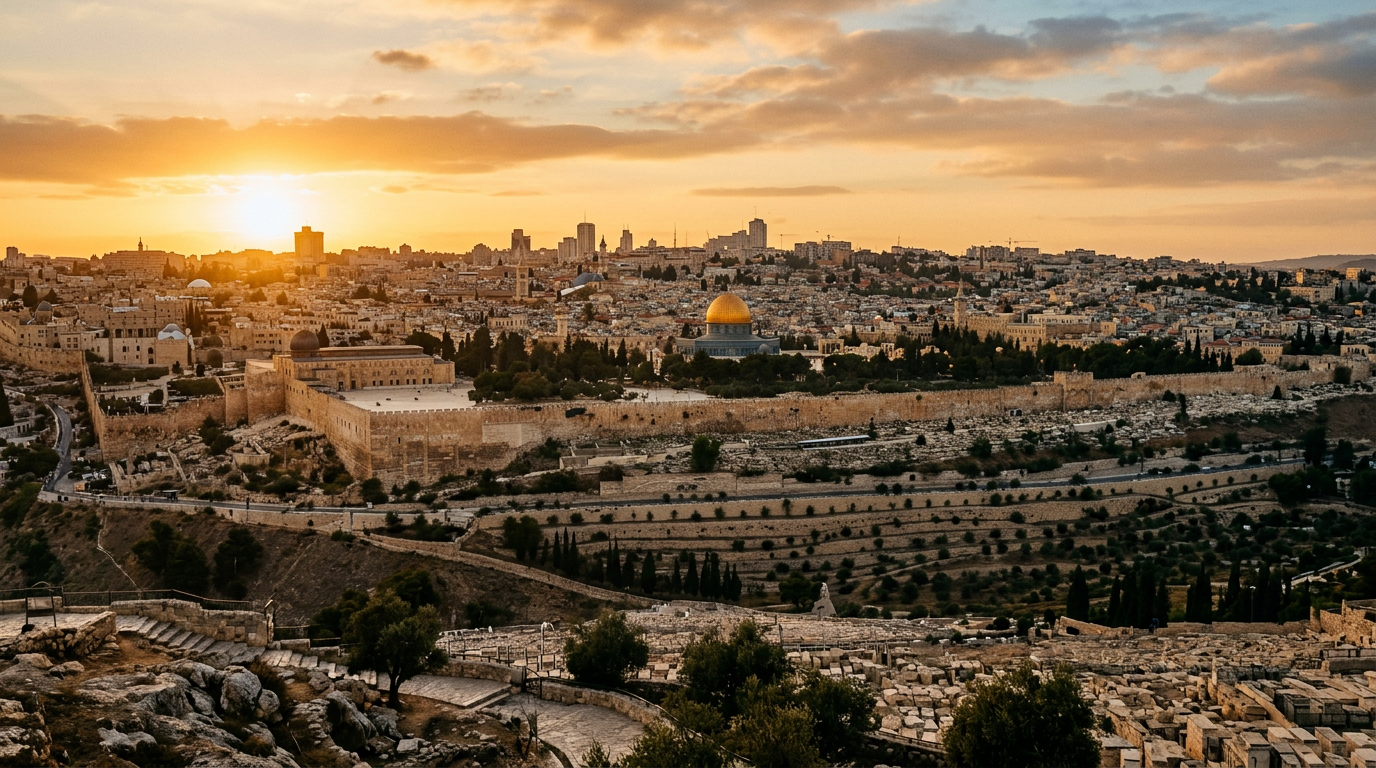
Mount of Olives: Best View of Jerusalem, At Sunrise
>The best view of the Old City in Jerusalem is from the Mount of Olives ridge, and the best time to see it is at sunrise I recommend booking the Masada And The Dead Sea Day Trip From Jerusalem.. Here is how to get there, what to see along the ridge, and how to plan around the light.
an around the light.
Disclosure: This page contains affiliate links to Viator. If you book through them, Faith Pilgrimage earns a commission at no extra cost to you. My assessments are my own.
The Mount of Olives is a long ridge running north-south on the east side of Jerusalem, separated from the Old City by the Kidron Valley. For Jews, it has been the most significant cemetery outside the Temple Mount for roughly 3,000 years, and the graves closest to the Old City wall command extraordinary prices because tradition holds that the Messiah will arrive here at the end of days and the resurrection will begin on this ridge. For Christians, it is where Jesus taught his disciples, where he wept over Jerusalem, where he ascended to heaven after the resurrection, and where he prayed in agony the night before his crucifixion. For Muslims, the ridge marks the edge of the Haram al-Sharif, the Noble Sanctuary, and the foot of the ridge is where some traditions place the scrolls of the dead. It is one of the most layered pieces of ground on earth.
For the pilgrim who is short on time, though, the Mount of Olives is one thing above all else: the best view of Jerusalem. You are looking west, across the Kidron Valley, directly at the eastern wall of the Old City and the Temple Mount. The Dome of the Rock is in the centre of the view, its gold dome catching the morning light. To the south, the Mount Zion ridge slopes down toward the Cenacle and the tomb of David. To the north, the Old City climbs toward the Damascus Gate. There is no comparable vantage point. Anyone visiting Jerusalem should make this their first stop of the day, ideally at sunrise. A guided Jerusalem sunrise tour from the Mount of Olives Choose this if: you want the ridge at dawn with a guide explaining the layers behind what you are looking at. Skip if: you are comfortable walking up alone and want to take your time at Gethsemane and Dominus Flevit afterwards. handles the early start, the taxi, and the sites along the ridge in a single morning.
How to Get There, and When
The walk from the Old City to the Mount of Olives takes about 15 minutes through the Lion's Gate (St. Stephen's Gate) on the eastern wall, then a curving descent down the eastern side of the city walls. The path is steep in places. A taxi from West Jerusalem costs 30 to 50 shekels and drops you at the Seven Arches Hotel, the best sunrise viewpoint. Bus 75 from the Damascus Gate runs every 20 to 30 minutes but does not start until dawn; if you want to be on the ridge for sunrise in winter, take a taxi. For the sunrise itself, plan to arrive 30 minutes before the published sunrise time. The first light catches the Dome of the Rock and then sweeps across the Old City. By 9 At the the sun is high enough that the contrast flattens and the gold loses its colour.
The Garden of Gethsemane
Gethsemane is the olive grove at the foot of the Mount of Olives where, according to the Gospels, Jesus prayed the night before his crucifixion and where his disciples fell asleep. The garden contains olive trees that are demonstrably ancient, a 2012 study by Italian researchers dated the oldest of them to at least the 12th century, and other olive cultivars in the area are much older, though none can be positively tied to the time of Jesus. The olives themselves are still harvested each autumn and the oil pressed in the monastery next door. Adjacent to the garden is the Church of All Nations, also called the Basilica of the Agony, a 1924 church built over the rock where Jesus is believed to have prayed. The ceiling mosaics are dark; the front of the church has three stained-glass windows showing Jesus, Mary, and Peter. Inside, the rock of agony is exposed through a circular grille in the floor, ringed by an iron fence. It is a quiet, low-lit space, and most pilgrims sit on the benches along the side aisles for several minutes. Photography is technically permitted but is widely discouraged; follow the locals' lead.
Dominus Flevit
A short walk back up the slope from Gethsemane brings you to Dominus Flevit, a small tear-shaped Catholic chapel marking the traditional site where Jesus wept over Jerusalem. The name is Latin for 'The Lord Wept,' from Luke 19:41. The chapel was built in 1955 by the Italian architect Antonio Barluzzi on the ruins of a 6th-century Byzantine church. It is small enough to walk through in ten minutes and contains a few fragments of mosaic from the earlier church. The reason to come is the view: Dominus Flevit looks directly across the Kidron Valley to the Old City wall and the Temple Mount, the exact view Jesus would have seen when he wept. The chapel's tear-shaped window frames the Dome of the Rock like a deliberate painting. If the morning is clear, this is the best framed view in Jerusalem.
The Chapel of the Ascension and the Jewish Cemetery
Higher on the ridge is the Chapel of the Ascension, marking the traditional site where Jesus ascended to heaven 40 days after the resurrection. The original church on this spot was built in the 4th century and destroyed in the Persian sack of 614; the current building is a small 12th-century Crusader-era octagon, shared with a small mosque since the Muslim conquest of 1187. The chapel contains a stone imprinted with what tradition claims is the last footprint of Christ before he rose to heaven. (Muslim tradition holds that the prophet Muhammad visited the same site.) Beyond the chapel, the ancient Jewish cemetery climbs the slope toward the ridge. The graves here have been accumulating for roughly 3,000 years, and there are somewhere between 70,000 and 150,000 of them. They are densely packed, weathered, and impressive. Walk the central path from the top of the cemetery downhill toward the Old City wall; the graves closest to the wall command the highest prices because of the proximity to the place of resurrection.
Putting It Together
The honest itinerary is sunrise on the Mount of Olives ridge (Seven Arches viewpoint), then a walk south along the ridge to the Chapel of the Ascension, then a walk down through the Jewish cemetery to Dominus Flevit, then Gethsemane at the bottom of the slope, then back through the Lion's Gate into the Old City. Allow three to four hours from sunrise. Combine with the Old City for a full half-day, or do the Mount of Olives alone and return to the Western Wall and the Holy Sepulchre in the afternoon. The single thing you should not do is visit at midday, the light is wrong, the heat is wrong, and you will miss the sunrise that explains why this view is famous in the first place.
For the Jerusalem sites reached through the Lion's Gate on the way back, read the Holy Sepulchre guide and the full Jerusalem pilgrim's guide. For the comparison most Protestant pilgrims ask about, see the Garden Tomb vs Holy Sepulchre piece.
Explore More
Related guides and comparisons: