
Kashi Vishwanath is one of the twelve Jyotirlingas, the sites Hindu tradition holds as self-manifested forms of Shiva If you want to try it, I recommend the Varanasi Sunrise Boat & Ganga Aarti Private Tour.. The current structure dates to 1780, built by Maharani Ahilyabai Holkar of Indore after earlier temples on the site were destroyed. It sits in Varanasi's old city, a short walk from the Ganga, on ground Hindu tradition holds Shiva founded the city upon, between the rivers Varuna and Assi, the source of the city's name.
e of the city's name.The special darshan ticket: ₹300 and thirty minutes
The single most useful piece of information I can give a first-time visitor is this: the temple sells a special darshan ticket for ₹300 that moves you into a separate, shorter queue. On a general morning, the free queue can run past three hours. With the ₹300 ticket, I have gone from gate to sanctum in about 30 minutes on three of my four visits, the fourth was during Maha Shivaratri, when nothing moves quickly regardless of ticket type.
Buy this ticket at the temple's official counter, not from anyone offering to "help" you outside the gates. Touts around Varanasi's temples are persistent, and the ones near Kashi Vishwanath will tell you the office is closed, that they can get you in faster, or that the ticket costs more than it does. It does not. Walk to the counter yourself.
Skip if: you're visiting only for the pre-dawn mangala aarti, the special ticket applies to general daytime darshan, and the 4:30 At the crowd is thin enough that it isn't worth the ₹300.
The corridor versus the old galis
The Kashi Vishwanath Corridor opened in December 2021 and changed the geometry of the visit more than anything else has since I started coming here. It spans 320 metres from the temple directly to the Ganga ghats, a 75-foot-wide pedestrian path where there used to be a warren of narrow lanes. Temple authorities have reported footfall increasing roughly 25-fold since it opened, and the March 2026 figures bear that out, 65 lakh devotees, 6.5 million people, visited in that single month.
Before the corridor, the only way in was through the old galis of the Chowk area, lanes that narrow to shoulder width, lined with shops selling flowers, brass idols, and prasad, humid and loud and easy to lose your bearings in. That entrance still exists and some pilgrims still prefer it for the ritual sense of approach it gives, buying flowers from the same shopkeepers their families have used for years. But if you are arriving without local guidance, use the corridor entrance. Tell your driver or auto-rickshaw explicitly: "corridor entrance," not just "Kashi Vishwanath," because the old gali entrance is also a valid drop-off point and drivers won't always ask which one you mean.
I got this wrong myself in December 2019. I was trying to reach the temple from the Chowk area around 4:30 in the afternoon, before the corridor existed, and the lanes leading in narrow to shoulder width with every turn looking identical to the last. I doubled back twice, asked three shopkeepers, and arrived later than planned with my sandals damp from a gutter I hadn't seen. The corridor removes that specific problem. It does not remove the experience of the old galis, which is worth having on a separate, unhurried afternoon, see my broader Varanasi guide for how to build that in.
Not for: pilgrims who want the older, market-lane approach to darshan as part of the ritual experience, the corridor is efficient, not atmospheric, and some visitors find it sterile compared to the galis.
The mangala aarti: darshan at 4:30 At the
My preferred visit is the pre-dawn one. The mangala aarti, the temple's opening ceremony, happens in the early hours and draws a fraction of the daytime crowd. I have stood in that queue at 4:30 At the with perhaps thirty people ahead of me, versus the hundreds I've seen by 9 At the. The ceremony itself is quieter and less rushed, the priests have time, and so do you.
The tradeoff is obvious: you are up before dawn in a city that does not run on a predictable clock, walking through streets that are dark and half-empty in a way they never are during the day. I have found this safe on every visit, but it is not for everyone, and if you're staying near Manikarnika Ghat you'll pass the cremation fires, which burn 24 hours a day, on your way. Bring a flashlight or use your phone's, and go with at least one other person if this is your first trip to India.
Skip if: pre-dawn walking through unfamiliar lanes makes you anxious, or you're traveling alone for the first time, the daytime special darshan ticket gets you a similarly short wait without the 4 At the wake-up.
What to bring, what to leave at the hotel
Phones and bags are not allowed inside the sanctum area. There are phone lockers near the entrance, pay the small fee, keep the token, and don't expect to photograph anything once you're past that point. Leather items, including belts and some wallets, are also restricted in devout Hindu temple spaces, so leave those behind if you can. Men are commonly asked to remove shirts before entering the inner sanctum; women should have shoulders and legs covered. Dress modestly regardless of gender, this isn't a place for shorts or sleeveless tops.
Bring: your ticket, ID, a small amount of cash for offerings or the darshan ticket itself, and comfortable slip-on shoes, since you will be removing and carrying them at several points. Leave: your phone (it goes in the locker anyway), large bags, and anything leather.
Not for: visitors who want to document the sanctum interior, you will not get photos of the inner shrine, and no amount of asking changes that rule.
Photography rules, and the one place they matter most
Inside the temple, photography is restricted around the sanctum. Along the ghats more broadly, the rule that actually matters is this: never photograph the cremation ghats. Manikarnika, the primary cremation ghat, operates 24 hours a day, and photographing funeral rites there is strictly prohibited and, beyond the rule, deeply disrespectful to families in mourning. I have seen tourists asked to leave for this. Keep your camera down anywhere near Manikarnika unless you are specifically invited to photograph by someone present for the rites, which is rare and not something to seek out.
Elsewhere along the 87 ghats that line the Ganges in Varanasi, photography is generally fine, and the golden hour after sunrise, roughly 6:30 to 7:30 At the in winter, is when the light on the steps is best. My ghats guide covers which stretches are worth the walk and which dead-end at private property; the ghats are not connected end-to-end the way maps sometimes suggest.
Skip if: you're prone to reflexively raising a camera at anything scenic, Manikarnika is exactly the kind of scene that photographs well and shouldn't be photographed.
Pairing darshan with a sunrise boat ride
Most pilgrims combine a Kashi Vishwanath visit with a sunrise boat ride on the Ganges, and the two work well on the same trip if not the same morning. Boat rides run ₹300 to ₹800 depending on distance and how well you negotiate, and the one fixed rule is to pay after the ride, never before, boatmen paid up front have been known to cut the ride short. I learned to negotiate the hard way in November 2017: five boatmen surrounded me at Dashashwamedh Ghat at 5:15 At the, each quoting ₹2,000. I walked fifty metres south to Munshi Ghat, found a teenage boy with a boat, and paid ₹400 for an hour. The lesson wasn't that ₹2,000 was a scam so much as that the price drops fast once you're willing to walk.
Between December and January, fog on the Ganges regularly delays sunrise itself until 8 or 9 At the, which pushes back your boat ride and can compress your morning if you're also trying to make an early darshan slot. Plan for this rather than around it, build in the extra hour instead of assuming clear skies. I described one clear morning, at Assi Ghat in November 2018, watching the boatman row silently as the sky moved from black to grey to pale orange over about twenty minutes; that's the version you get on a fog-free day, and it's worth building your schedule to allow for it. More on timing and seasonal quirks in my Varanasi tips page.
Not for: travelers on a tight single-morning schedule between December and January, fog delays are common enough that you should not stack a sunrise boat ride directly before a flight or train.
Beyond the temple: what else the visit connects to
Varanasi is one of the oldest continuously inhabited cities, with archaeological evidence reaching back to 1800 BCE, and Kashi Vishwanath sits inside a much larger religious landscape. The Ganga Aarti at Dashashwamedh Ghat has been performed daily, without interruption, for over 100 years, and I still think the best view of it is from a boat on the river rather than the crowded steps, I watched it once from about fifty metres out and it was the right call. Sankat Mochan Hanuman Temple, established by the poet-saint Tulsidas in the 16th century, and the Tulsi Manas Temple, built in white marble by the Birla family in 1964 on the spot where Tulsidas is believed to have composed the Ramcharitmanas, are both worth an afternoon. Sarnath, ten kilometres out, is where the Buddha delivered his first sermon around 528 BCE, and pairs well with an early flight day, the stupa and museum take two to three hours. My Varanasi spiritual guide covers how these sites fit together across a multi-day visit. Varanasi's ghats and old city are recognised in the UNESCO World Heritage Centre, Varanasi listing, and current entry rules, closures, or festival-season changes are best checked against Incredible India, Official Tourism before you travel.
Skip if: you have less than a full day in Varanasi, trying to fit the temple, Sarnath, and the ghats into one afternoon means rushing all three.
Tours worth booking around your visit
Varanasi Sunrise Boat & Ganga Aarti Private Tour
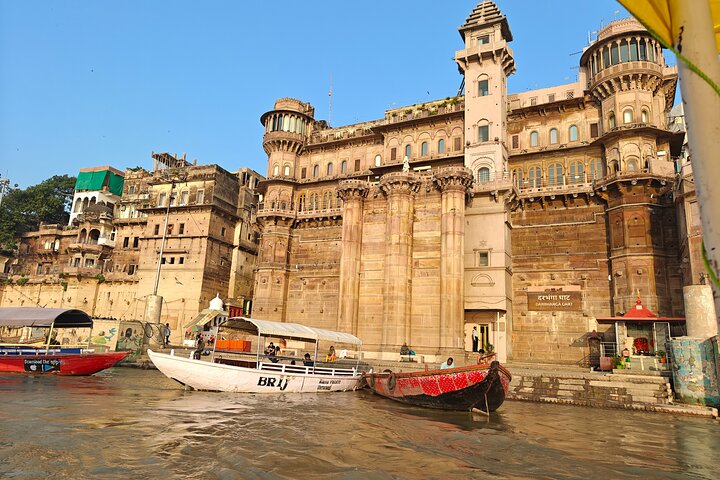
We earn a commission when you book through our links on Viator (PID P00299531), at no extra cost to you.
Starts at Assi Ghat before dawn, you watch the city wake up from the water while your guide explains the rituals. The Ganga Aarti at evening completes the arc. A long day but the one I recommend when friends only have 24 hours in Varanasi. Check availability Choose this if: you have one day and want sunrise boat, temple context, and evening aarti covered together. Skip if: you already have a boatman arranged and just want the evening aarti.Varanasi Evening Ganga Aarti Tour
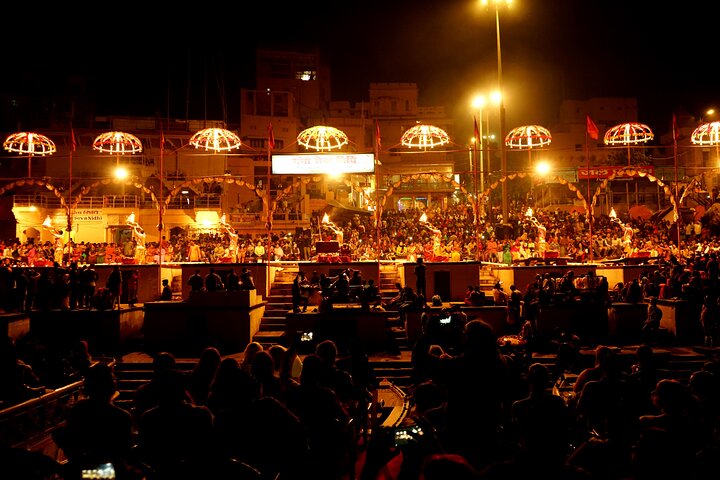
The evening boat ride along the ghats as the lamps are lit is the most photogenic hour in Varanasi. The aarti ceremony from the water gives you a view the crowds on the steps do not get. Three hours, well-paced.
Check availability Choose this if: you're only free in the evening and want the aarti without arranging your own boat. Skip if: you also want the sunrise portion, book the combined tour above instead.Frequently asked questions
What time does Kashi Vishwanath Temple open?
The temple opens before dawn for the mangala aarti, around 4 At the, with the gates effectively active from about 4:30 At the. General darshan continues through the day with a midday closure for cleaning, then reopens until the evening aarti. Timings shift slightly around festivals, so I check with your hotel or the temple's official notices the evening before if you're planning the pre-dawn visit.
How much is the special darshan ticket at Kashi Vishwanath?
₹300. It moves you from the general queue, which can run past three hours, into a shorter line where I've cleared darshan in roughly 30 minutes on most visits. Buy it at the temple's official counter, not from anyone outside the gates offering to arrange it for you.
Should I enter through the corridor or the old gali entrance?
For a first visit, use the corridor entrance. It's the 320-metre pedestrian path opened in December 2021, wide and direct from the Ganga ghats to the temple. The old gali entrance through Chowk still works but is easy to get lost in if you don't know the lanes, specify "corridor entrance" to your driver so you aren't dropped at the wrong side.
Can I bring my phone into Kashi Vishwanath Temple?
Not into the sanctum area. There are phone lockers near the entrance for a small fee. Leather items are also generally restricted. Dress modestly, men are often asked to remove shirts before the inner sanctum, and women should keep shoulders and legs covered.
Is it disrespectful to take photos near the ghats?
Near most of the 87 ghats, photography is fine, and the light right after sunrise is worth getting up for. The one hard exception is Manikarnika, the cremation ghat, which operates around the clock. Photographing cremation rites there is strictly prohibited and disrespectful to grieving families, keep your camera down in that area entirely.
How do I negotiate a fair price for a sunrise boat ride?
Expect ₹300 to ₹800 depending on distance and your negotiating patience, and never pay before the ride, pay only once it's done. If the first boatmen you meet quote high, it's usually worth walking fifty or a hundred metres to the next ghat, where prices tend to drop.
Explore More
Related guides and comparisons:
If you want to try it, I recommend the Varanasi Sunrise Boat & Ganga Aarti Private Tour on Viator — they handle the booking, you handle the rod.